1. Exposure Control in High-Glare Whitewater
Ocean surfaces behave like moving mirrors next to deep shadows inside the wave pocket. If you leave an action camera or mirrorless body on standard matrix metering, a sudden burst of sunlit foam will cause the camera to stop down abruptly, turning the surfer's face into a muddy silhouette. Set an exposure compensation of -0.7 EV on GoPro Hero12 Black, DJI Osmo Action 4, or Sony Alpha bodies inside Aquatech Edge housings. Protecting the highlights in breaking foam preserves the texture of the lip; shadows in the trough can be lifted cleanly in post-production if you shoot in a flat 10-bit log profile (GP-Log, D-Log M, or S-Log3).
Equally important is manual shutter discipline. Standard 180-degree shutter rules (such as 1/120s for 60fps) work well on land with neutral density filters, but inside the impact zone they render flying water droplets as soft streaks and degrade digital stabilization. Force a minimum shutter speed of 1/1000s (or 1/2000s under midday sun) so every bead of rail spray stays crisp and gyroscopic stabilization algorithms have sharp edges to track.
| Camera / Rig Type | Resolution & Aspect | Frame Rate | Shutter & EV Offset | Primary Surf Use |
|---|---|---|---|---|
| Action Cam (Mouth Mount) | 4K (8:7 or 4:3 Tall) | 120 fps | 1/1600s, -0.7 EV | POV tube rides & steep drops |
| Mirrorless + Dome Port | 4K DCI (17:9) 10-bit | 60 fps / 120 fps | 1/1250s, -0.3 EV | Split over-under & pocket swims |
| Beach Telephoto (500mm) | 4K UHD (16:9) | 60 fps | 1/1000s, 0.0 EV | Lineup compression & air reversals |
| 360 Dual-Lens Cam | 5.7K Active HDR | 60 fps | Auto High, -0.5 EV | Tail-pad angle & coach analysis |
2. Board Mounts, Bite Mounts, and Safety Leashes
Where you place the camera dictates both image stability and physical safety during a wipeout. Nose adhesive plugs (FCS compatible) offer a classic look back at the surfer's stance, but they suffer from three drawbacks: constant pearl-diving submersion, added swing weight on the tip of the board, and a flat angle that hides the wave ahead. If you mount on the deck, cure the 3M VHB adhesive pad for a full 24 hours at room temperature before hitting cold salt water, and always loop a braided Dacron safety tether to the center plug.
For true point-of-view immersion, a silicone bite mount paired with a high-visibility orange float sponge keeps the lens aligned with your eyes and leverages your neck as a natural gimbal. Practice breathing through the side air channels while paddling before taking on overhead sets. Between waves, tuck the camera onto a chest wetsuit zip loop so your jaw rests and your hands stay free for duck-diving.
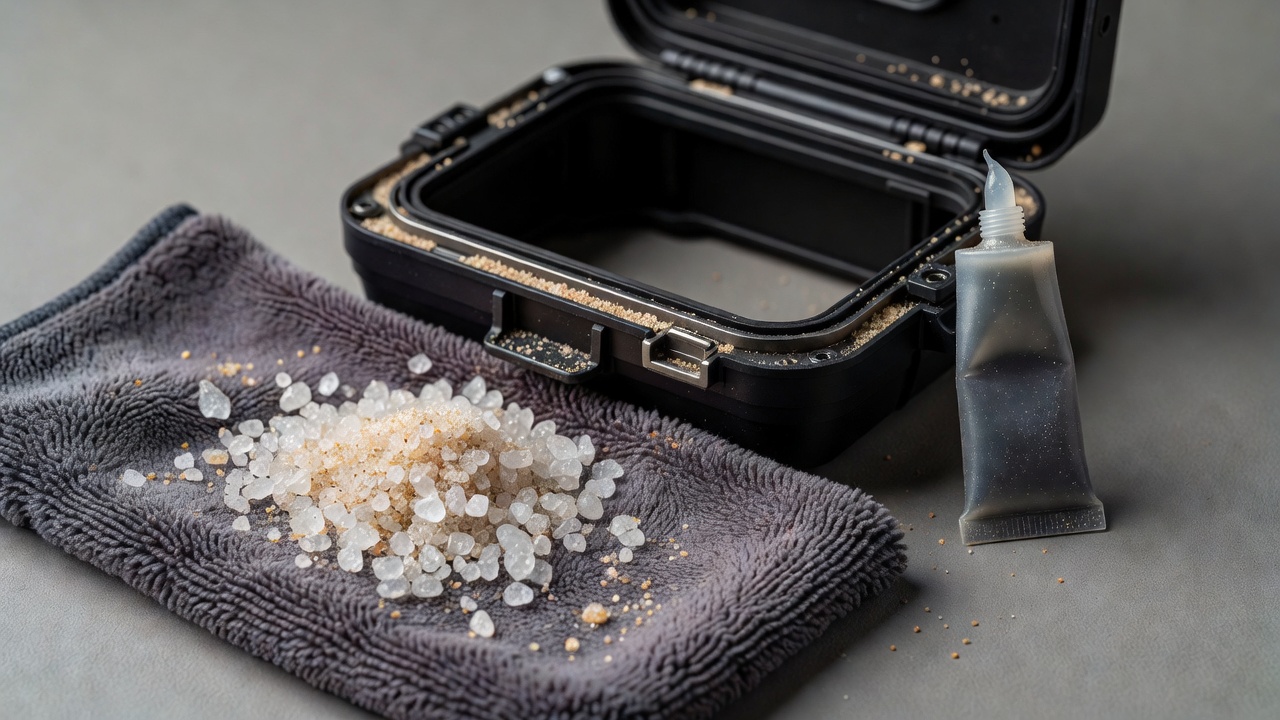
3. Waterproof Housing Maintenance & Anti-Fog Routine
Water housings from Aquatech, Salty Surf Housings, and Liquid Eye rely on even compression across a rubber O-ring. Before every session, run a lint-free microfiber corner along the channel and apply only enough silicone grease to make the O-ring glisten—excess grease acts like flypaper for sand and surfboard wax crumbs. Drop two baked silica desiccant packets inside the lower shell before latching the backplate. When warm camera electronics meet 13°C ocean water, any trapped humid air condenses directly on the inside center of the lens element, ruining an entire two-hour swim.
For the exterior port, carry a small bottle of diluted baby shampoo or apply a fresh layer of Rain-X (glass ports only; never use alcohol-based repellents on acrylic domes as they cause micro-crazing). Dip the housing underwater for ten seconds immediately upon entering the shorebreak so the exterior glass reaches thermal equilibrium with the sea.
"Never swap batteries in the parking lot breeze. One gust of fine dune silt across an open latch channel will cost you a camera body at three meters depth." — Workshop Bench Rule #1